Coming soon. Pensacola gets more annual rainfall than Seattle, and it arrives in bursts that overwhelm undersized gutters in minutes. Elite Pro Roofing’s upcoming commercial division will design, fabricate, and install commercial gutter systems and custom metal work built for that reality: box gutters, oversized downspouts, scuppers, conductor heads, coping, and flashing, all sized to your roof area and pitch instead of pulled off a shelf. When water leaves your roof the way it’s supposed to, your walls, foundation, and inventory stay dry. That’s the whole job, and it’s worth doing right — call (888) 373-1474 to join the interest list.
Drainage is an engineering problem, not an accessory
Most commercial gutter failures around here weren’t caused by bad materials. They were caused by nobody doing the math. A 20,000-square-foot roof shedding a summer thunderstorm moves an enormous volume of water, and a residential-profile gutter on a commercial fascia is a downstream flood waiting to happen. Overflow doesn’t just make puddles; it saturates masonry, undermines slabs, rots fascia, and stains the storefront your customers look at every day.
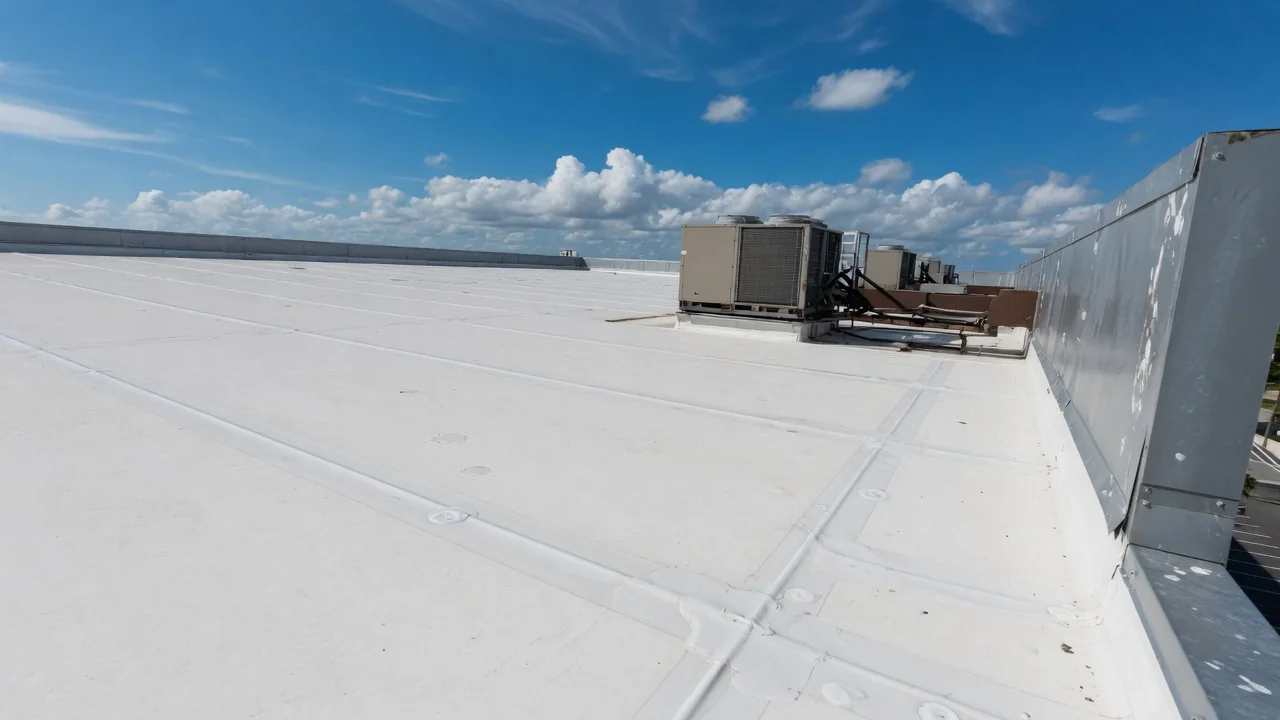
The design process starts with the numbers: roof square footage, slope, local rain intensity, and where the water actually needs to go. From there the gutter profile, the downspout count and placement, and the outlet sizes get spec’d. On flat and low-slope roofs, that often means interior drains backed up by through-wall scuppers, so a clogged drain becomes a visible overflow instead of a ponding roof. The division’s flat roof systems service will correct drainage as part of a repair or re-roof rather than as an afterthought.
Custom fabrication, fit to the building
Off-the-shelf metal fits off-the-shelf buildings. Older commercial structures in downtown Pensacola and along the coast rarely qualify. The division will fabricate gutters, trim, and flashing to match the building in front of it: box gutters in the exact profile the fascia calls for, parapet coping bent to the wall’s true width, counterflashing that follows a stucco reveal instead of fighting it.
Custom work also means you’re not stuck with builder-grade appearance. Color-matched metal in commercial gauges, clean miters, and concealed fasteners make the drainage system part of the architecture rather than something bolted onto it. Property managers notice the difference at the curb; building inspectors notice it in the details.
Large-scale systems for large roofs
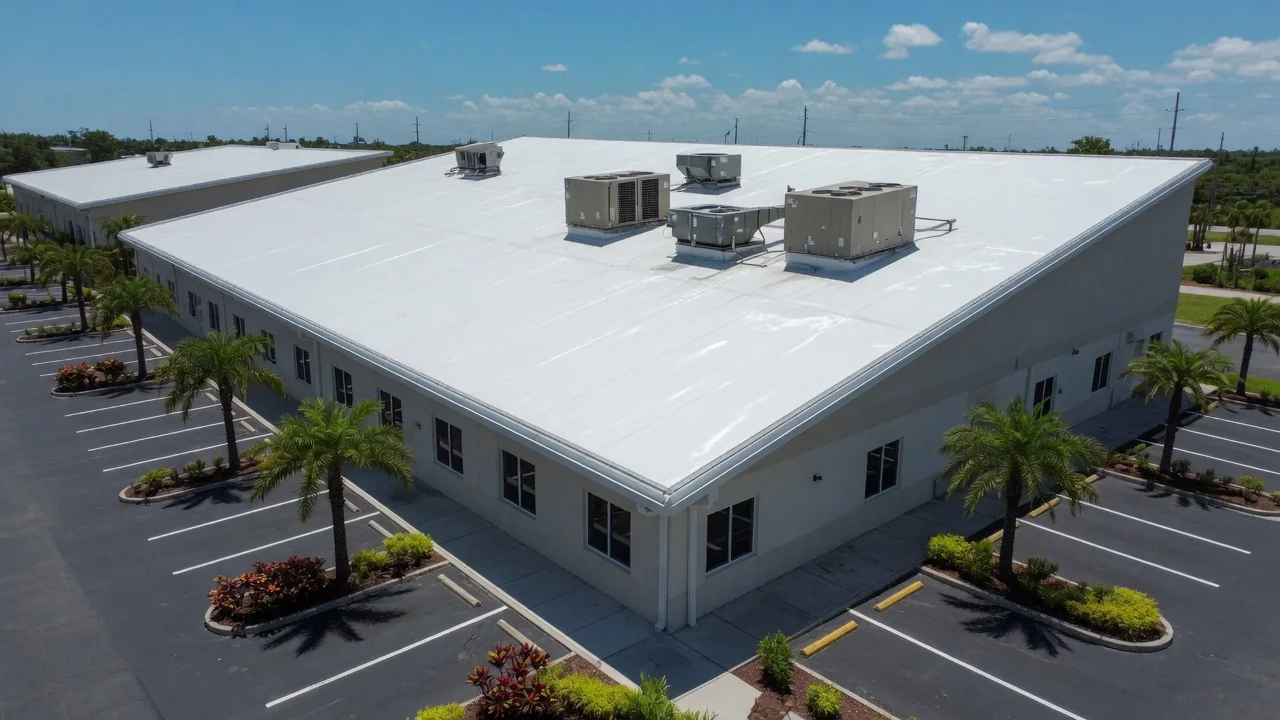
Big roofs punish shortcuts. On warehouses, churches, retail centers, and multi-tenant buildings from Pensacola to Navarre, the division will install continuous commercial gutter runs with expansion joints where thermal movement demands them, hangers spaced for real water weight, and downspouts tied into site drainage so the water ends up away from the slab instead of against it.
Coastal wind is part of the design load too. A gutter that rattles loose in a tropical storm becomes a projectile, and the fascia it tears away exposes the roof edge, which is exactly where wind wants to get under a roof. Edge metal and gutters get fastened to resist uplift, not just gravity, because the roof edge is where Gulf Coast roofs win or lose.
Maintenance, repair, and storm response
The division will service commercial gutter systems it didn’t install: re-pitching runs that have sagged out of slope, resealing seams, replacing crushed downspouts, and clearing systems that haven’t seen a ladder in years. If a storm took your gutters or edge metal, that damage is frequently covered by your commercial policy along with the roof itself, and the planned insurance claims service will document it and meet the adjuster on the roof so nothing gets missed while you’re busy running the business.
One habit worth stealing from our best clients: put your gutters on the same schedule as your HVAC. A twice-yearly inspection costs next to nothing and catches the sagging hanger or blocked outlet before it turns into interior water damage over your inventory.
“Crew of 7 showed up on time, started promptly and finished the job in 1 day… The crew head came back the next day, to pick up any wandering nails on my lawn. Even cleaned my gutters!” — Larry Kanzler, Google review
Frequently asked questions
What size gutters does a commercial building need?
It depends on roof area, pitch, and rain intensity, not on what the last contractor happened to have on the truck. Many commercial buildings here need 6-inch or larger profiles with oversized downspouts. It gets calculated per building, with the sizing logic shown in the estimate.
Do you fabricate custom metal for older buildings?
Yes. Custom fabrication is half this trade. The division will bend box gutters, coping, and flashing to match existing profiles on older structures, which keeps historic and legacy buildings watertight without wrecking their look.
Can gutters be added to a flat roof?
Usually the better answer is a combination: interior drains or scuppers moving water off the roof, with gutters and conductor heads managing it down the walls. The whole path gets designed from membrane to grade, since a flat roof with nowhere to send water is just a pool with a building under it.
Will insurance cover storm-damaged gutters?
Often, yes. Wind and hail damage to gutters and edge metal is commonly covered under the same claim as roof damage. Damage gets photographed and documented end to end, coordinated with your insurer — the same process our residential customers rely on today, carried into commercial roofing claims when the division opens.
If your building’s drainage is undersized, leaking, or storm-damaged, call Elite-Pro at (888) 373-1474 or contact us for a free estimate. We’ll measure the roof, run the numbers, and quote a system engineered for Gulf Coast rain, fabricated to fit your building, and installed by crews who clean up like they were never there.